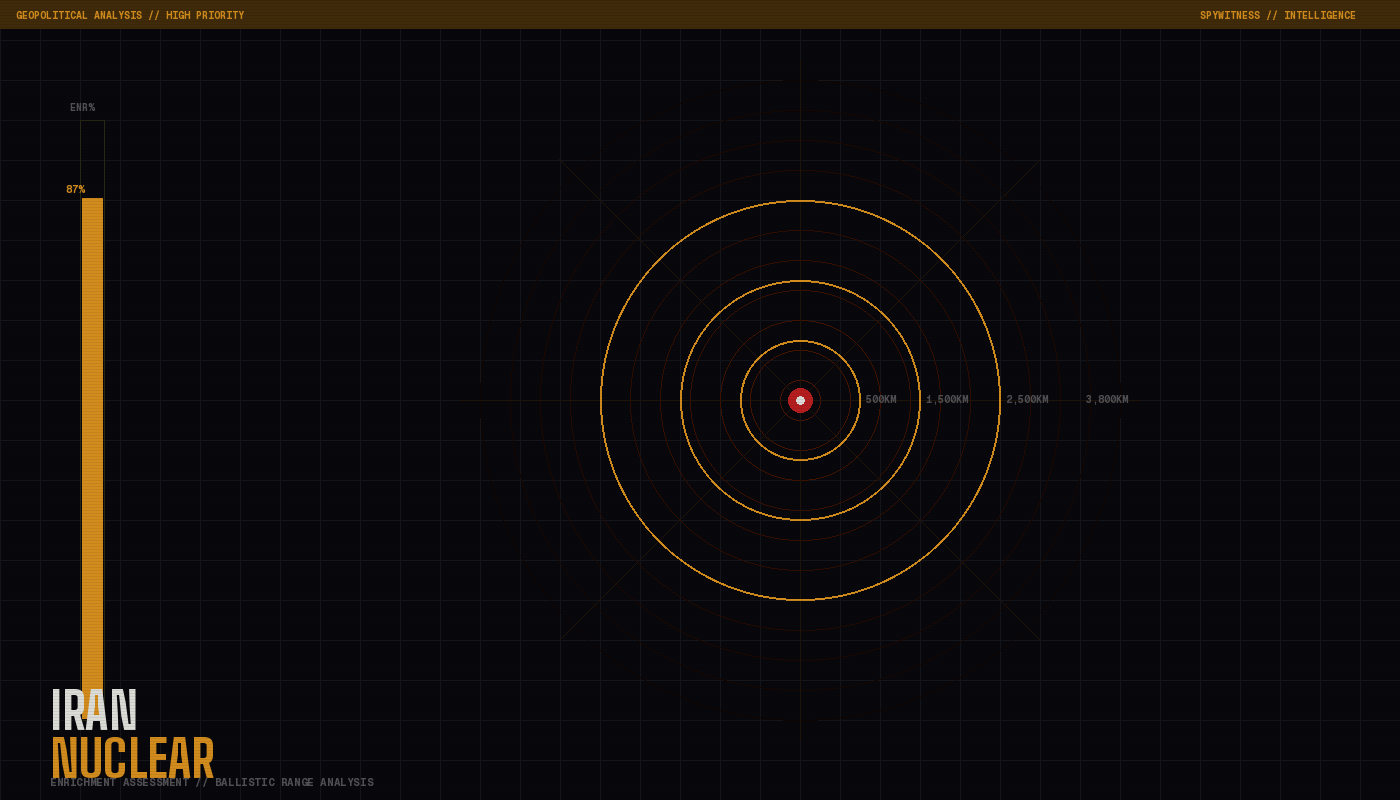
Iran's nuclear programme has advanced to a point where the strategic decision point long anticipated by US and Israeli planners has arrived. Either a negotiated framework constrains Tehran's enrichment activity under verifiable terms, or the window for credible military interdiction closes. Neither option is clean and neither is cost-free. The Trump administration is being asked to make the defining non-proliferation decision of the decade with intelligence indicating that Iran's technical capability has already reached a threshold where delay carries compounding strategic cost.
Current assessments, drawing on IAEA reporting and US intelligence community analysis, indicate Iran has accumulated sufficient highly enriched uranium to produce multiple nuclear devices and has continued work on warhead-relevant components. The confirmed ballistic missile delivery capability — demonstrated in Iran's direct attack on Israeli territory using over 300 missiles and drones in April 2024 — removes the theoretical separation between a bomb and the ability to deliver it at regional range. Iran's official denial of weaponisation intent is increasingly difficult to sustain in the face of this technical convergence.
The diplomatic track faces structural obstacles. The Abraham Accords architecture, which Israel used as a foundation for regional security arrangements, is under sustained pressure from the Gaza conflict and its aftermath. Saudi Arabia — the central actor in any expanded normalisation framework — has conditioned further movement on Palestinian state commitments the current Israeli government has publicly refused. This limits the diplomatic leverage available to Washington in any negotiating framework that requires Arab partner buy-in to be durable.
The military option, while kept formally available, faces structural difficulties that have not improved since prior administrations assessed it. Iran's nuclear infrastructure is geographically distributed, hardened, and partially located at depth. Assessments consistently indicate that even a comprehensive strike campaign could delay rather than eliminate the programme, at the cost of regional escalation, Strait of Hormuz disruption, and mobilisation of Iranian proxy forces across multiple theatres. The counterargument — that a degraded programme bought under military pressure is preferable to a complete programme under diplomatic restraint — has active proponents in both Washington and Tel Aviv.
The assessment at moderate confidence is that the Trump administration will pursue a negotiated framework as the primary track while maintaining the credible military option as leverage. Available reporting suggests back-channel contacts are active. The critical variable is what Iran will accept — whether Tehran can make the concessions on enrichment levels and verification access that a durable agreement requires, given the domestic political weight the nuclear programme carries inside Iran itself.