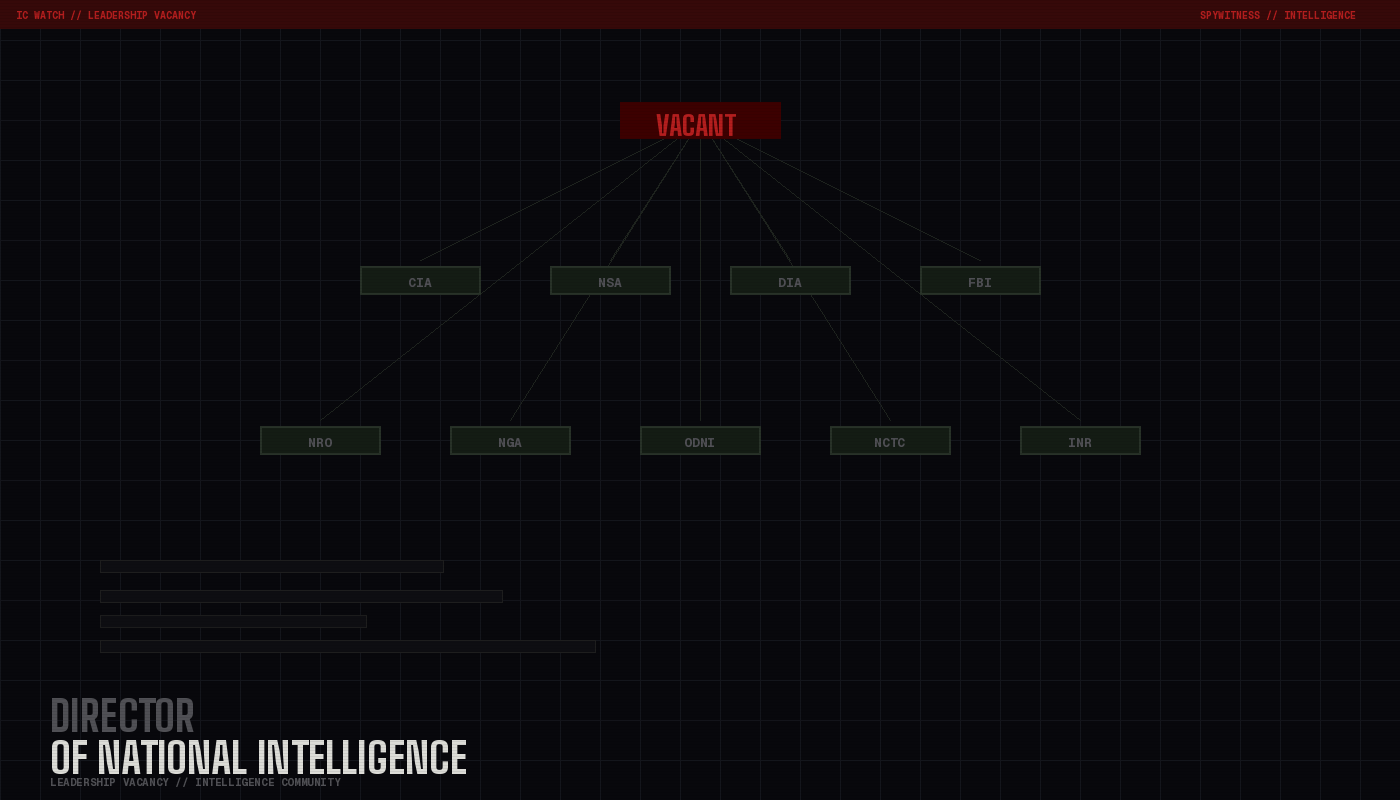
Tulsi Gabbard's departure from the role of Director of National Intelligence creates a senior leadership gap at the apex of the US intelligence community at a structurally sensitive moment. The timing — coinciding with mid-execution of the administration's $9 billion artificial intelligence investment in IC operations and following a period of significant personnel disruption — compounds the operational risk beyond a standard leadership transition.
Gabbard was confirmed as DNI in early 2025 following a confirmation process that drew significant scrutiny over her prior foreign policy positions. Her tenure was marked by stated commitments to reducing what she characterised as the politicisation of the intelligence community, moves that resulted in departures of senior career officers from multiple agencies. The cumulative effect on institutional continuity at senior levels across the IC is assessed as significant.
The DNI position sits above the 18-element intelligence community as its primary coordinator and interface with the National Security Council. Vacancies at this level historically correlate with reduced intelligence integration across agencies — a structural problem the IC has identified as a systemic weakness in multiple post-failure reviews. The current environment, with active intelligence operations supporting Ukraine, monitoring Iran's nuclear programme, and managing ongoing Chinese cyber threat remediation, makes a leadership gap particularly consequential.
The $9 billion AI investment is assessed as particularly vulnerable to leadership instability. Technology transformation programmes of this scale require sustained political backing and day-to-day executive authority to manage inter-agency competition for resources and capabilities. Without a confirmed DNI, that authority defaults to acting leadership that carries less political weight and faces greater bureaucratic resistance from agencies protecting existing programmes and budget lines.
The critical unknown is the succession timeline. Senate confirmation of a new DNI typically requires weeks to months; in a politically contested environment the process can extend further. The acting DNI arrangement provides operational continuity at lower political authority. Watch whether the administration moves to nominate a successor quickly, and whether that nominee comes from within the career intelligence community or from outside it — a signal of whether the next phase prioritises operational credibility or political control.