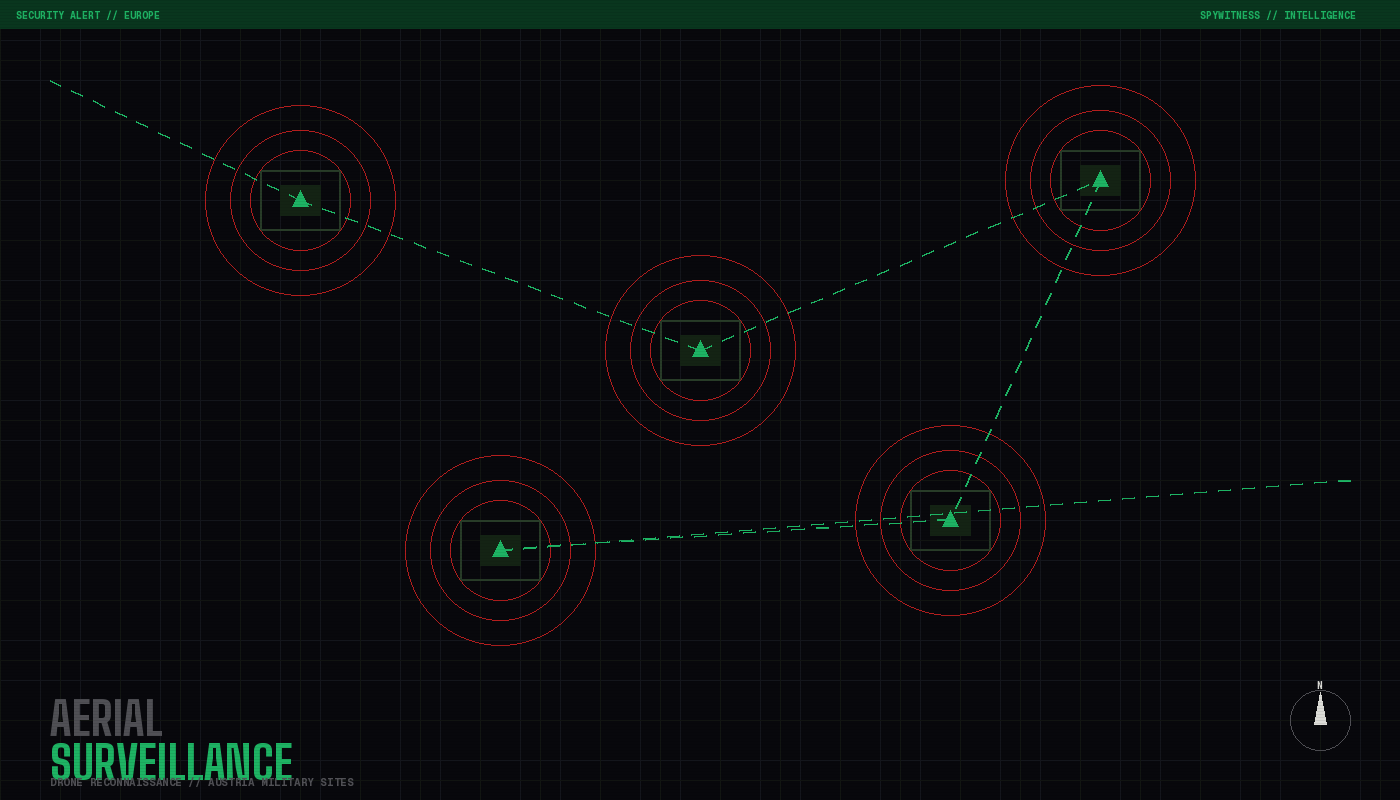
Austrian authorities have confirmed the detection of systematic unmanned aerial vehicle surveillance targeting military installations across the country, with the pattern of operations assessed with high confidence as representing deliberate intelligence collection rather than isolated incidents or civilian misuse. The confirmation places Austria in a growing list of European states that have identified what security officials describe as a coordinated campaign of drone-based reconnaissance against defence infrastructure.
Austrian military and interior ministry officials have confirmed multiple detected intrusions at sensitive military sites, describing the flight patterns as methodical and oriented toward perimeter mapping, entry point identification, and facility layout documentation. The drones used in confirmed incidents are assessed as commercially available platforms modified for extended range and enhanced camera capability — an approach that provides operational deniability while delivering meaningful reconnaissance value. Austrian counterintelligence officials have not made a public attribution, but available reporting indicates the working assessment is Russian-origin.
Austria's formal neutrality does not reduce its strategic intelligence value. The country hosts a significant number of international organisation headquarters, has historically functioned as an intelligence hub for both Eastern and Western services, and lies adjacent to NATO members through whose territory Ukraine-support logistics pass. Its neutrality, which excludes it from NATO's collective defence mechanisms, simultaneously makes it a lower-cost surveillance target — an operation that would risk a harder collective response against an alliance member can be conducted against Austria with reduced escalatory risk.
The Austrian pattern follows similar confirmed incidents in Scandinavia, Germany, the United Kingdom, and the Baltic states over the preceding 18 months. EUFOR Althea infrastructure in Bosnia and NATO logistics facilities in Poland have reported analogous activity. The cumulative picture — if the operations share a common directing authority — is of a systematic effort to map European military and dual-use infrastructure, timed to the protracted Ukraine conflict and assessments of potential NATO involvement scenarios.
Austria's formal response options are constrained by neutrality status and the absence of NATO's Article 4 consultation mechanism. The government is assessed as relying primarily on criminal law enforcement and diplomatic channels, both of which carry limited deterrent value against a state actor. The more consequential response will emerge from Austrian counterintelligence — the BVT and its successor structures — as they assess whether the drone operations are a prelude to human intelligence or cyber operations targeting the same facilities.